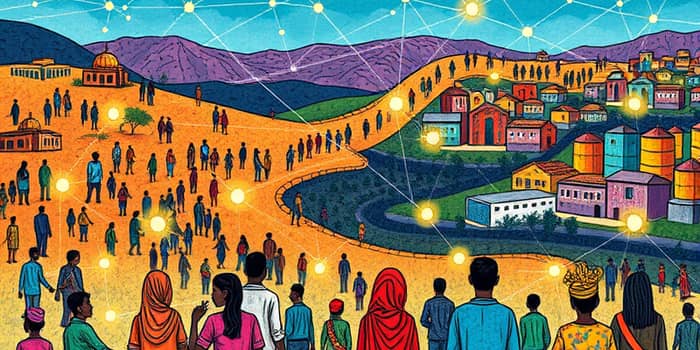
In a world where 1.3 billion adults remain unbanked, the promise of digital finance has never been more urgent.
By harnessing rapid digital transformation across low-income regions, innovative solutions can unlock new opportunities for millions.
As we confront systemic barriers, fintech’s role grows clearer: enabling secure savings, reliable credit, and equitable services for those long overlooked by legacy systems.
Understanding the Unbanked Challenge
The term “unbanked” describes adults who lack access to a formal financial account at a bank or similar institution. Despite global efforts, nearly 75 percent of adults in developing countries now have an account, leaving roughly 1.3 billion people unserved.
In the United States, more than 4.2 percent of households were unbanked in 2023, and an additional 14.2 percent remain underbanked, relying on alternative financial services such as payday loans and prepaid cards. Volatile-income households face rates nearly twice the national average, illustrating how economic instability compounds exclusion.
In Indonesia, government initiatives and mobile wallets lifted account ownership from 36 percent in 2014 to 48.9 percent by 2017, yet rural areas still lag behind urban centers. Across emerging markets, 345 million of the world’s 400 million micro-enterprises operate informally, missing out on the financing that could fuel growth, job creation, and resilience.
FinTech Innovations at Work
Financial technology firms are stepping into the breach, delivering innovations in mobile money services and tailored credit solutions. By leveraging mobile penetration and big data analytics, these startups provide accessible tools that traditional banks cannot.
Key examples include:
- Tala: Uses machine learning for credit scoring in Kenya, Mexico, India, and the Philippines, offering instant loans to customers without formal histories.
- U Bank: In Pakistan, grew its loan portfolio fivefold over five years, serving over 400,000 rural clients with microloans and digital savings accounts designed for low-income users.
- Neobanks in Latin America issuing low-fee accounts with integrated budgeting tools, while AI chatbots provide 24/7 financial coaching to underserved communities.
These innovations demonstrate how agile fintech models can reach remote populations, reduce costs, and scale quickly to meet rising demand, even where infrastructure is minimal.
Tracking Progress and Metrics
According to the Global Findex 2025 report, account ownership has climbed from 50 percent in 2011 to nearly 80 percent today. However, 300 million accounts remain inactive, highlighting persistent trust and usability issues.
The Global Financial Inclusion Index rose from 41.7 in 2022 to 49.4 in 2025, driven by digitization, instant payments, and open banking frameworks. A one percent increase in financial literacy correlates with a 2.8 percent drop in loan defaults and a 6.7 percent reduction in debt-to-income ratios.
The focus is shifting from mere access to active usage. Recognizing mobile device ownership as a prerequisite, regions like Sub-Saharan Africa and South Asia are prime targets for continued growth.
Overcoming Remaining Barriers
Despite encouraging trends, significant obstacles remain. Funding shifts and donor fatigue threaten long-term sustainability, while policy misalignment and data privacy concerns can slow implementation.
Major barriers include:
- Lack of formal identification documents and legal exclusion
- Connectivity gaps preventing reliable internet or smartphone access
- Inactive accounts eroding user trust and engagement
- Persistent gender disparities in financial access, leaving women disproportionately unbanked
Closing these gaps requires coordinated efforts that blend technology, regulation, and community outreach to build ecosystems where users feel empowered and protected.
Charting the Path Forward
The next frontier in financial inclusion lies at the intersection of emerging technology and collaborative frameworks. Innovations such as stablecoins and AI-driven financial solutions promise secure, low-cost cross-border payments and personalized services capable of serving diverse user needs.
Governments and regulators can accelerate inclusion through open banking mandates, interoperable digital IDs, and incentives for fintech to serve low-income users. Private investors should align impact goals with sustainable business models that reward long-term growth over short-term returns.
Events like the New York Fed’s “Economy That Works for All” summit and OECD/INFE financial literacy workshops are driving global dialogue, sharing best practices, and setting benchmarks for the years ahead.
Conclusion
Bridging the gap between the banked and unbanked is not only a moral imperative but also an engine for economic growth. Every percentage point increase in account ownership translates into greater savings, investment, and poverty reduction.
By supporting public-private partnerships fueling inclusive growth and embracing long-term resilience over short-term funding cycles, stakeholders can ensure fintech innovations reach those who need them most. As we embark on this critical mission, each stakeholder—from policymakers to fintech entrepreneurs and end-users—has a role to play in turning aspiration into reality.
References
- https://www.diplomaticourier.com/posts/fintech-standoff-opportunity-unbanked
- https://www.centerforfinancialinclusion.org/financial-inclusion-in-2026-progress-funding-shifts-and-the-next-phase-of-the-sector/
- https://www.youtube.com/watch?v=gyj4gJ_QfGE
- https://www.weforum.org/stories/2024/07/why-financial-inclusion-is-the-key-to-a-thriving-digital-economy/
- https://www.lifehealth.com/progress-in-global-financial-inclusion-stalls-after-two-years-of-significant-improvement/
- https://www.clevelandfed.org/publications/economic-commentary/2026/ec-202602-accounts-of-the-unbanked-and-underbanked
- https://www.finastra.com/financial-services-state-nation-survey-2026
- https://guides.loc.gov/fintech/21st-century/unbanked-underbanked
- https://www.newyorkfed.org/newsevents/events/regional_outreach/2026/0114-2026
- https://www.inswitch.com/blog/fintech-trends-for-2026-stablecoins-ai-and-a-b2b-focus-as-the-engine-of-growth
- https://www.slalom.com/us/en/insights/financial-services-outlook-2026
- https://www.fintechfutures.com/bankingtech/the-global-unbanked-shoppers
- https://www.oecd.org/en/publications/oecd-infe-toolkit-for-measuring-financial-literacy-inclusion-and-well-being-2026_92f2d439-en.html
- https://www.bdo.com/insights/industries/fintech/2026-fintech-industry-predictions