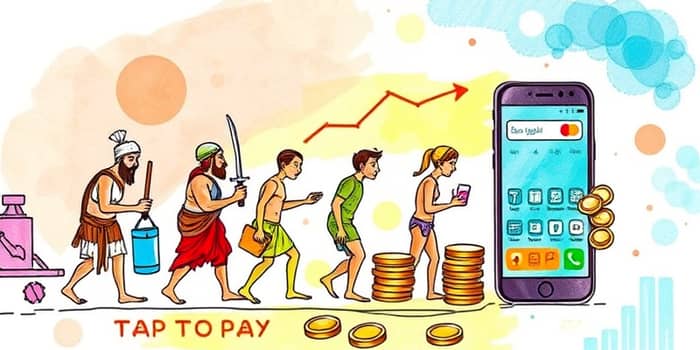
In a journey spanning more than nine millennia of monetary change, humanity has transformed the way we exchange value. From ancient barter systems to gold coins, and then paper money, each innovation built upon the last. Today, with a simple tap of a smartphone, we can complete transactions that once took days or weeks. This article explores how payment processing evolved from the earliest forms of exchange to the seamless digital experiences we enjoy today.
Ancient Roots to Cards
For thousands of years, trade relied on direct exchange of goods or standardized metal tokens. Around 806 AD, coins became widespread across empires, providing a portable and trusted medium of exchange that displaced cumbersome bartering. By the 17th century, drawn notes known as cheques emerged in London, allowing account holders to settle debts without transferring physical coins or bullion.
The 19th century brought the first Electronic Funds Transfer experiments with telegraphic systems, yet the real revolution arrived mid-20th century. In 1950, the first modern credit card was introduced, enabling consumers to purchase goods on credit across large merchant networks. Barclays’ deployment of the first ATM in 1967 and the invention of the magnetic stripe in 1969 laid the technical foundation for electronic transactions that would dominate decades to come.
Digital Dawn and the Internet Revolution
By the 1980s, Automated Clearing Houses and the SWIFT network began replacing paper checks with secure electronic transfers. Online banking debuted in the UK and the U.S., giving early adopters the power to check balances and transfer funds from home. The true turning point occurred in 1994 when a consumer purchased a CD online via NetMarket, marking the first recorded consumer online payment.
The mid-1990s saw the birth of eBay and the integration of online ordering by Pizza Hut, driving demand for reliable digital payment gateways. The introduction of PayPal in 1998 revolutionized peer-to-peer and business transactions, providing an easy, email-based system that would grow to over 426 million active accounts by 2021. Within a decade, digital commerce had become an essential part of daily life.
Swipe Dominance to Tap Emergence
From the 1970s onward, most card payments used magnetic stripes swiped through terminals. While secure for its time, this technology was vulnerable to cloning and required physical presence. The 1990s brought EMV chip cards, greatly reducing fraud through dynamic authentication, but the user experience still involved insertion or swipe.
Contactless technology emerged in the early 2000s, leveraging NFC and tokenization to enable fast, tap-to-pay transactions. As smartphones and wearables adopted this technology, consumers began to leave behind their plastic cards. The pandemic accelerated this shift, with merchants and shoppers embracing quick and contactless point-of-sale experiences to reduce physical contact and improve convenience.
- Magnetic stripe era (1969-2010s): swipe and insert transactions
- EMV and chip adoption: enhanced security through cryptography
- NFC-based tap-to-pay: smartphones and cards
- QR codes: app-driven payments in retail and dining
- Wearables and IoT: payments via watches and connected devices
Contactless Explosion in the Modern Era
Today, contactless payments account for the majority of card interactions in many economies. Over 95% of U.S. merchants now offer terminals that support NFC, and QR code payments have democratized digital acceptance for small businesses worldwide. Digital wallets like Apple Pay, Google Pay, and Samsung Wallet aggregate multiple cards into one interface, backed by dynamic one-time tokens for secure checkout.
Biometric authentication such as fingerprints, facial recognition, and even voice or eye scans has added another layer of protection. The launch of Apple Pay in 2014 showcased how convenience and safety could coexist, while PayEye’s commercial eye recognition system introduced in 2019 pointed toward future possibilities. With these tools, payments become nearly invisible, integrated seamlessly into daily routines.
Looking Ahead: Innovations on the Horizon
Advances in AI, machine learning, and blockchain are poised to further transform how we move money. Real-time payment rails like Faster Payments in the UK and SEPA Instant in Europe settle funds in seconds, improving liquidity for businesses and consumers alike. Financial institutions are exploring tap-on-phone solutions to turn any smartphone into a merchant terminal, expanding acceptance across emerging markets.
The Internet of Things will embed payment capabilities into cars, household appliances, and wearable devices. Imagine a world where your smartwatch automatically orders and pays for groceries as you run out of essentials. These trends are driven by a relentless pursuit of speed, security, and simplicity, ensuring that tomorrow’s transactions will be even more invisible than today’s.
- Real-time payment networks: instant settlements and increased efficiency
- AI-driven fraud detection: proactive security measures
- IoT payment integrations: connected devices and automated billing
- Embedded finance: seamless credit, insurance, and banking offerings
Key Metrics and Milestones
Embracing the Shift: Benefits and Challenges
The transition from swipe to tap offers unmatched benefits: faster checkouts, reduced fraud, and data-driven loyalty programs that reward consumer behavior in real time. Merchants benefit from lower transaction costs and improved customer satisfaction. For banks and fintechs, emerging technologies open new revenue streams in real-time analytics, embedded services, and cross-border transfers.
Yet challenges remain. Legacy infrastructures can slow adoption in developing regions, and regulatory frameworks must adapt to protect consumer data without stifling innovation. As blockchain and cryptocurrencies gain traction, questions around interoperability and environmental impact demand careful consideration. Addressing these issues will require collaboration across industries and governments.
Conclusion
From coin and paper to chip, swipe, and ultimately the invisible tap, the journey of payment processing reflects our deepest drives for convenience, trust, and security. In just sixty years, we have condensed countless innovations into devices that fit in the palm of our hands. As we look to the future, evolution of payments promises seamless transactions, ensuring that the next chapter will be as transformative as the last.
References
- https://truust.io/blog/the-evolution-of-payments-industry/
- https://www.tryedge.io/blog/future-of-contactless-payments-unlocking-the-cutting-edge-technologies-and-innovations-transforming-transactions
- https://argozconsultants.com/the-evolution-of-payment-systems/
- https://www.gulfmanagementsystems.com/2025/07/23/the-future-of-contactless-payment-10-trends-businesses-cant-afford-to-ignore/
- https://www.icterra.com/the-history-and-future-of-payment-trends/
- https://www.marqeta.com/blog/tapping-into-the-future-a-guide-to-contactless-payments
- https://y.uno/post/history-of-digital-payments
- https://www.fsb1879.com/blog/the-evolution-of-contactless-payments-and-their-benefits
- https://histoire.bnpparibas/en/18-dates-that-made-the-history-of-payments/
- https://www.mastercard.com/global/en/news-and-trends/stories/2025/tapping-into-the-future-of-payments.html
- https://www.qualtrics.com/articles/customer/sale-advancements-history/
- https://www.worldpay.com/en/insights/articles/payment-technology-trends-2025
- https://www.mx.com/whitepapers/55-years-technology-banking/
- https://www.csiweb.com/what-to-know/content-hub/blog/contactless-payments-the-future-of-digital-payment-technologies/
- https://www.jpmorgan.com/payments/payments-unbound/magazine/articles/visual-timeline-payment-rails