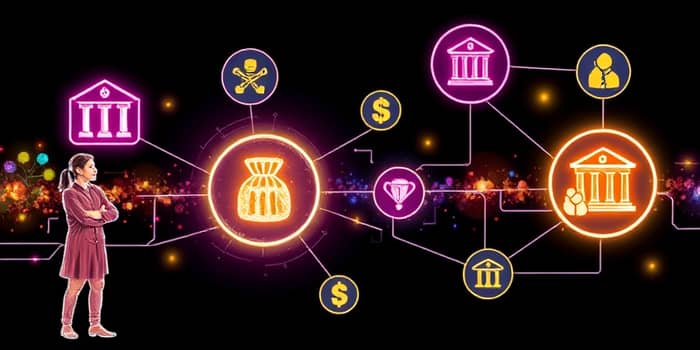
In an era defined by digital innovation, financial data has become a powerful catalyst for change. Open finance builds on the foundation of open banking to deliver a truly interconnected ecosystem that spans beyond traditional bank accounts and payment services.
By enabling secure sharing of broader financial data, open finance empowers individuals and businesses to harness insights from every corner of their financial lives. This approach shifts the industry toward collaboration and personalized solutions.
Imagine a small business owner who once juggled spreadsheets and multiple online portals to track cash flow, taxes, and loans. Through a unified open finance platform, they now see all accounts, insurance coverages, and investment allocations in one interface. Such a transformation demonstrates how consumers with control over their data can make smarter decisions with less effort.
Understanding Open Finance
At its core, open finance allows consumers to share diverse financial information—from insurance policies and investment portfolios to retirement accounts and loan records—through standardized APIs. These APIs replace insecure methods like screen scraping, ensuring data is transmitted safely and efficiently between trusted parties.
While open banking focuses on bank account details, transactions, and payment initiation, open finance integrates data across banking, insurance, pensions, mortgages, and credit services. This combining banking, insurance, and investments unlocks new possibilities for personalized financial solutions, such as dynamic risk assessments and tailored lending offers.
Data flows through interoperable systems that adhere to common protocols, making it possible for any compliant application to access relevant information. As standards mature, consumers will experience seamless onboarding, faster service delivery, and a reduction in manual data entry errors.
Key Principles Driving Open Finance
Effective open finance frameworks rest on guiding principles that protect consumers and foster trust. These principles support a secure, transparent environment where data flows safely between consenting parties.
- Explicit, granular, revocable consent—Consumers decide exactly which data to share and can withdraw permissions at any time, preserving autonomy and privacy.
- Interoperability—Systems communicate seamlessly through common standards and protocols, reducing integration friction.
- Transparency and accountability—Providers must disclose how data will be used, with clear audit trails and adherence to ethical guidelines.
- Data minimization—Only the data necessary to accomplish a specific task is shared, limiting exposure of sensitive information.
- Security—APIs replace screen scraping, ensuring robust defense against unauthorized access, backed by encryption and tokenization.
Adopting these principles not only builds consumer confidence but also encourages more financial institutions and fintech innovators to participate in the open finance ecosystem.
Transformative Benefits for Consumers and Businesses
As open finance matures, its positive impact extends across user experiences and business models. Both individuals and organizations stand to gain from more intelligent, data-driven offerings.
- Consumers gain a holistic view of personal finances, enabling better budgeting, planning, and decision making without toggling between multiple services.
- Platforms can deliver tailored advice, such as customized insurance recommendations or retirement strategies based on a complete financial footprint.
- Businesses enjoy innovation and new revenue streams by building services around richer, cross-sector data, from bespoke lending products to instant investment rebalancing.
- Faster product development and improved risk assessment lead to cost savings, enhanced customer experiences, and increased loyalty.
Consider a young professional planning for homeownership. An open finance application could aggregate her savings, credit history, insurance coverages, and future pension projections to recommend optimal mortgage options. This level of personalization was unimaginable in traditional, siloed banking environments.
Navigating Challenges and Risks
Despite its promise, open finance introduces challenges that require careful management. Stakeholders must collaborate to address potential pitfalls and maintain consumer trust.
- Privacy and security concerns—Ensuring data protection under regulations like GDPR and CCPA, and preventing unauthorized access or breaches.
- Regulatory uncertainty—Varying frameworks across regions can complicate compliance and slow adoption.
- Potential data misuse—Safeguards are needed to prevent unauthorized analytics or profiling that could harm consumers.
- Technological barriers—Legacy systems, inconsistent standards, and integration costs can impede seamless data exchange.
By implementing token-based, secure API connections and establishing stringent oversight mechanisms, organizations can mitigate these risks while reaping the benefits of open finance.
The Global Regulatory Landscape
Jurisdictions worldwide are crafting policies to balance innovation with consumer protection. In the European Union and United Kingdom, regulations have evolved beyond PSD2 into a formal open finance framework emphasizing transparency, accountability, and expanded data scope.
Across the Atlantic, the United States takes a market-driven approach, with industry-led standards like FDX and platforms such as Akoya and MX championing secure data sharing. While not mandated by law, these initiatives align with overarching privacy statutes such as CCPA.
Achieving global interoperability demands alignment between regional guidelines and international privacy laws. Harmonized standards will enable cross-border financial services, reducing friction for multinational consumers and businesses.
Looking Ahead: The Future of Open Finance
The evolution from open banking to open finance represents a stepping stone toward even broader data ecosystems, often referred to as 'smart data.' By integrating non-financial datasets—like healthcare records, utility payments, or government benefits—future platforms can deliver unprecedented insights into overall well-being.
Emerging technologies such as artificial intelligence and machine learning will leverage open finance infrastructures to power predictive analytics, proactive fraud detection, and real-time financial coaching. Users will benefit from contextual recommendations that anticipate their needs.
Collaboration among banks, fintechs, insurers, government agencies, and regulators is crucial. Together, they can construct a resilient ecosystem that promotes financial inclusion, supports underserved populations, and drives sustainable economic growth.
Open finance is more than a technical standard—it is a mission to create a more equitable and innovative financial world. By encouraging transparency, accountability, and consumer-centric design, stakeholders can ensure that data sharing benefits all participants.
Ultimately, open finance invites us to dream bigger about what is possible when information flows freely and securely. As users and providers engage with this model, they participate in reshaping the financial landscape together, unlocking opportunities for growth, learning, and prosperity.
For individuals, open finance means greater control, smarter choices, and enriched financial literacy. For businesses, it means tapping into uncharted markets, offering differentiated products, and forging deeper customer relationships. The combined effect is a financial ecosystem that is adaptive, transparent, and human-centered.
Now is the time for everyone—from end users to regulators—to embrace open finance principles, collaborate on robust standards, and champion a future where financial empowerment is accessible to all.
References
- https://www.insurely.com/open-finance
- https://en.wikipedia.org/wiki/Open_finance
- https://www.mx.com/blog/what-is-open-finance/
- https://latinia.com/en/resources/from-open-banking-to-open-finance
- https://akoya.com/blog/open-finance-vs-open-banking-whats-the-real-difference
- https://www.mastercard.com/us/en/news-and-trends/Insights/2026/what-is-open-finance-your-essential-guide.html
- https://stripe.com/resources/more/what-is-open-finance-here-is-what-you-need-to-know
- https://openyls.law.yale.edu/bitstreams/f326b0e1-5478-4271-8b4c-96250464818b/download
- https://www.openbanking.org.uk/open-finance/