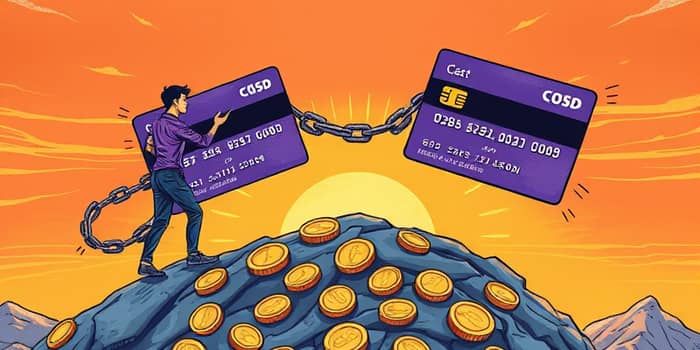
Credit card debt can feel like a weight chained to your financial freedom. With balances soaring into the trillions, millions of Americans navigate a landscape where rising interest rates compound stress and payments seem never-ending. This article offers a comprehensive roadmap to reclaim control, combining eye-opening statistics, proven strategies, and real-world examples. Whether you’re at the start of your debt journey or searching for fresh solutions, you’ll find actionable guidance designed to spark hope, build momentum, and set you on a path to lasting relief.
Understanding the National Credit Card Debt Crisis
As of Q4 2025, Americans collectively carry an astonishing $1.277 trillion in total credit card debt, the highest sum recorded since 1999. Over the past five years, balances have surged by $507 billion, a 66% increase that dwarfs pre-pandemic levels. Meanwhile, the average cardholder with unpaid balances owes $7,886, marking a steady rise in individual liability. More than 61% of borrowers have carried their debt for at least one year, with nearly one in five burdened for five years or more.
These figures underscore a critical reality: credit card debt is no longer a short-term fix but a long-term challenge. As rates and balances climb, without intervention, many families risk facing a cycle of interest payments that outstrip principal reductions, hampering progress toward financial goals like homeownership, retirement, or emergency savings.
State-by-State Variations: A Closer Look
Debt levels vary dramatically across the nation. States like Connecticut, New Jersey, and Maryland top the list with average balances near $9,700, while Mississippi, Arkansas, and West Virginia hover below $5,400. In Washington state, debt spiked by nearly 12% over a single year—the fastest growth in the country.
Recognizing these regional differences can help tailor solutions. In high-balance states, targeted counseling and local assistance programs may offer community-specific perks, whereas residents in lower-debt areas might focus on preserving healthy credit habits to prevent escalation. Regardless of where you live, understanding local trends adds context to your personal journey and highlights the universality of this challenge.
Refinancing and Consolidation Methods
Fortunately, a spectrum of refinancing and consolidation strategies exists, each designed to reduce rates, simplify payments, or access home equity. Choosing the right path depends on your unique profile—income, credit score, and long-term objectives.
- Balance Transfer Cards – Leverage introductory 0% APR offers to shift high-interest balances.
- Personal Loans – Secure a fixed-rate loan to consolidate multiple cards into one payment.
- Cash-Out Refinancing – Tap home equity by refinancing your mortgage with a larger loan.
- Home Equity Loans – Borrow against your property with a second mortgage at usually lower rates.
- Peer-to-Peer Loans – Fund consolidation through online marketplaces connecting borrowers and investors.
- Credit Counseling – Partner with nonprofit agencies for structured debt management plans.
- Borrowing from Friends or Family – Consider informal arrangements with clear terms to avoid strain.
Navigating Key Considerations
Before selecting an option, weigh the trade-offs. Application inquiries can temporarily knock your score, while fees and closing costs may erode savings. Clarify repayment timelines to avoid surprises and ensure that lower interest rates translate into real progress rather than extended obligations.
This snapshot empowers you to compare costs and benefits at a glance. Always request personalized quotes and read the fine print to confirm that projected savings outweigh any upfront expenses.
A Step-by-Step Strategy Framework
A systematic approach demystifies the process and keeps you on track. Follow these steps to chart your path from confusion to clarity:
- Debt Assessment – List all balances, rates, and due dates to reveal your total obligation.
- Option Exploration – Research offerings from banks, credit unions, and online platforms.
- Cost Comparison – Calculate total interest and fees across timelines to identify the best deal.
- Apply Strategically – Time applications to minimize credit impact and maximize approval odds.
- Implement and Monitor – Transfer balances or fund loans, then track progress monthly.
Consistency in payment habits accelerates results and guards against future pitfalls, transforming a daunting mountain of debt into manageable milestones.
Projected Savings and Next Steps
To illustrate the impact, consider moving a $10,000 balance from a 22% APR credit card to a personal loan at 10% APR over three years. You could save over $1,400 in interest and slash your monthly payment by nearly $100. For homeowners, cash-out refinancing at historically low mortgage rates can unlock even deeper savings, often cutting total interest by thousands of dollars while preserving valuable equity.
Now is the moment to take action. Arm yourself with knowledge, consult trusted nonprofit counseling services or financial advisors, and engage with lenders offering prequalification checks. By demystifying the process, you’ll transform uncertainty into confidence, turning what once felt like a financial prison into a clear roadmap toward lasting debt freedom and peace.
Embracing a Brighter Financial Future
Beyond the numbers and strategies lies a deeper reward: the empowerment that comes from mastering your finances. Every payment you make, every decision you research, is a step toward reclaiming time, energy, and possibilities. Imagine the relief of seeing your balances dwindle, of redirecting funds toward your dreams—family vacations, home improvements, or a comfortable retirement.
Financial freedom is within reach when you couple discipline with the right refinancing tools. Use this framework as your compass, adapt it to your life, and celebrate each milestone. In doing so, you become not just a borrower, but a strategist—charting a course toward a future defined by choice, not obligation.
References
- https://www.americanexpress.com/en-us/credit-cards/credit-intel/credit-card-refinance/
- https://www.lendingtree.com/credit-cards/study/credit-card-debt-statistics/
- https://www.debt.org/consolidation/
- https://www.amerisave.com/learn/how-to-pay-off-credit-card-debt
- https://newsroom.transunion.com/2026-consumer-credit-forecast/
- https://www.nerdwallet.com/personal-loans/best/debt-consolidation-loans
- https://www.newyorkfed.org/microeconomics/hhdc
- https://www.bankrate.com/loans/personal-loans/debt-consolidation-loans/
- https://www.philadelphiafed.org/surveys-and-data/large-bank-credit-card-and-mortgage-data
- https://www.experian.com/loans/debt-consolidation/
- https://www.nationaldebtrelief.com/resources/credit-card-debt-relief/credit-card-debt-stats/
- https://www.peopledrivencu.org/other/debt-consolidation/is-debt-consolidation-worth-it-a-2026-analysis/
- https://www.federalreserve.gov/releases/g19/current/
- https://www.incharge.org/debt-relief/debt-consolidation/best-way-consolidate-debt/