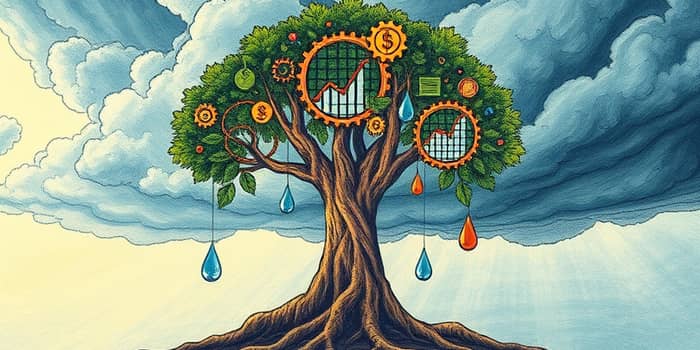
In an era where storms, floods, and extreme heatwaves are no longer distant projections but daily headlines, financial institutions face a stark choice: cling to outdated models or embrace a strategic pivot. This article unveils how banks and investors can transform climate adversity into growth, crafting solutions for both the most vulnerable communities and the innovators driving adaptation.
Drawing on the latest analyses of risks and the pioneering frameworks reshaping the sector, we explore practical steps to bridge data gaps, segment clients effectively, and build lasting competitive advantage. Prepare to reframe resilience as an engine for innovation and profits.
Understanding the Risk Repricing Challenge
Conventional climate risk platforms often understate true exposure. Recent studies reveal a four-fold gap between projected portfolio losses and real vulnerability. This mispricing stems from prioritizing long-term 2050 scenarios over near-term material exposure horizons where decisions actually occur. Institutions that ignore this discrepancy risk sudden market repricing and stranded assets.
Physical hazards and transition shocks unite to form a complex threat landscape. From carbon pricing upheavals to intensifying floods, companies must confront risks that unfold within the next decade. Acknowledging this reality is the first step toward meaningful action.
- Physical climate hazards intensifying every year
- Underestimated transition risks in models
- Sector differences spanning fourfold variance
Strategic Segmentation: Managing Risk and Capturing Growth
To navigate evolving market risks, banks must adopt a two-part segmentation strategy. First, identify high-growth clients innovating adaptation solutions—those developing climate intelligence, drip irrigation, and fire-resistant materials. Second, pinpoint high-risk clients requiring resilience financing—from smallholder farmers to coastal real estate developers facing acute hazards.
This dual approach allows institutions to balance risk reduction with capturing double-digit growth opportunities. By tailoring products and incentives, banks can both protect vulnerable clients and partner with innovators driving the next wave of climate solutions.
Data Engagement: Bridging the Quantification Gap
Despite incomplete vendor data and inconsistent metrics, qualitative engagement proves indispensable. Surface-level climate scores fail to capture how critical a single asset may be. Banks can employ methodologies like PCRAM 2.0 to structure conversations, shift from abstract risk flags to asset-level adaptation planning, and influence decisions at optimal lifecycle stages.
Timing is crucial. Engaging early—during asset planning or pre-deal due diligence—amplifies impact. This proactive stance not only refines risk assessments but also strengthens relationships with clients who value tailored support.
Implementing a Five-Step Bank Risk Reduction Framework
Emerging market banks can integrate risk mitigation with value creation through a coordinated five-step framework:
- Regularly review portfolios to rebalance exposures and divest selectively
- Treat climate risks as core financial risks by embedding them into underwriting
- Build institutional readiness with data systems, trained staff, and governance
- Develop market-leading client solutions for both segments
- Leverage concessional finance strategically to de-risk investments
By executing these steps simultaneously, banks can avoid reactionary fixes and lay a foundation for sustainable growth. Harnessing concessional capital alongside commercial funding unlocks new opportunities and demonstrates leadership in a competitive landscape.
Seizing Competitive Advantage Through Early Action
First movers in adaptation and resilience financing can lock in significant first-mover advantage, establishing brand leadership and deep client loyalty. Early adopters refine risk assessment models, build targeted product suites, and position themselves as trusted partners to both vulnerable communities and cutting-edge innovators.
This edge extends beyond mere market share. Institutions that move swiftly demonstrate to regulators and investors a genuine commitment to managing climate risks, enhancing reputation and unlocking preferential access to green funding streams.
Organizational Readiness: Building Internal Capabilities
Start with scenario planning that goes beyond static assessments. Develop a centralized decision-making hub to coordinate responses and institutionalize continuous improvement through post-incident analysis. Cultivate cross-functional teams combining risk analysts, sustainability experts, and product developers, fostering a culture that treats adaptation as a strategic priority.
Invest in training, real-time risk monitoring tools, and governance mechanisms that ensure climate considerations permeate every level of decision-making. This holistic approach transforms resilience from a compliance exercise into an integral part of your organizational DNA.
Conclusion: Embracing the Art of the Pivot
The path forward demands boldness and agility. Financial institutions that pivot effectively will not only shield themselves from escalating losses but also unlock unprecedented growth. By segmenting clients, bridging data gaps through engagement, and executing a rigorous risk reduction framework, banks can turn the tide on climate adversity.
Ultimately, adaptation becomes more than a cost center—it evolves into a catalyst for innovation and competitive differentiation. The time to pivot is now. Lead with purpose, invest in resilience, and watch your institution flourish amid change.
References
- https://www.bcg.com/publications/2026/how-emerging-market-banks-finance-resilience
- https://www.iigcc.org/insights/adaptation-resilience-corporate-engagement-priorities-2026
- https://www.everbridge.com/blog/global-risks-to-watch-in-2026/
- https://www.fticonsulting.com/insights/articles/climate-change-adaptation-2026
- https://www.morganstanley.com/im/en-us/individual-investor/insights/articles/2026-research-themes.html
- https://www.responsible-investor.com/adaptation-and-resilience-2026-opportunities-and-standardisation-in-focus/
- https://investments.metlife.com/insights/macro-strategy/global-risks-outlook-2026/
- https://www.science.org/doi/10.1126/science.aea7431
- https://news.lehigh.edu/lehigh-researchers-propose-new-solutions-to-address-climate-change-risks
- https://www.mitigasolutions.com/blog/climate-risk-predictions-2026