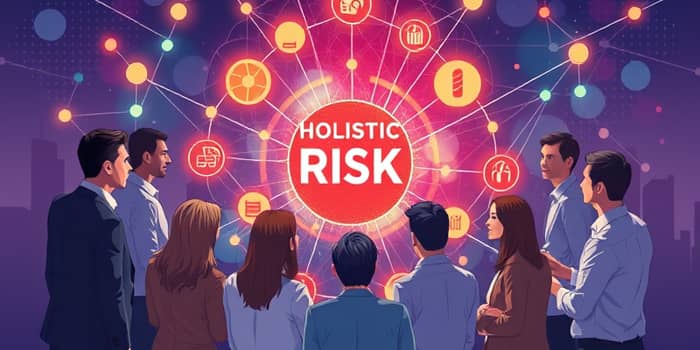
In today’s fast-evolving business landscape, uncertainty can feel overwhelming. Yet, organizations that embrace a unified, strategic approach to risk not only survive—they thrive. This article explores how holistic risk governance empowers leaders to transform challenges into opportunities and build a resilient future.
Understanding Holistic Risk Governance
Holistic risk governance is more than a compliance exercise: it’s a mindset. By integrating enterprise-wide risk management with governance, organizations gain a clear, top-down view of every threat and opportunity. This unified framework aligns with strategic objectives and fosters transparency, empowering boards and executives to navigate complexity with confidence.
Central to this approach are three pillars: governance, risk management, and compliance (GRC). When these pillars intersect seamlessly, decision-makers can prioritize the most critical risks, allocate resources wisely, and seize strategic advantages.
Building the Governance Foundation
Every successful framework begins with bold leadership and clear direction. The board of directors and executive team must collaborate to define a risk appetite that reflects the organization’s values and long-term goals. From here, a comprehensive risk charter lays out roles, responsibilities, and processes.
- Set goals and define risk appetite: Engage stakeholders to align tolerance levels with strategic vision.
- Create a risk charter document: Establish scope, authority, and accountability.
- Assign ownership and policies: Ensure every risk has a clear steward.
- Implement assessment processes: Use workshops and data analysis to identify emerging threats.
- Develop action plans: Prioritize initiatives with cost-benefit analysis and timelines.
Leading with Purpose and Accountability
True governance lives in the actions of its leaders. The board sets the tone, approving the overarching framework and providing ongoing oversight. The Chief Risk Officer (CRO) orchestrates enterprise risk management, while the Chief Compliance Officer (CCO) ensures policies meet regulatory and ethical standards. Technology leaders—CIOs and CISOs—provide the tools and data security to monitor progress in real time.
Establishing a risk committee or Enterprise Governance Board reinforces accountability. Regular meetings keep senior leaders focused on high-impact risks, and progress reports drive transparency across departments.
From Silos to Synergy
Traditional risk management often operates in silos—finance here, IT security there—leaving gaps that can grow into crises. A holistic approach dissolves these barriers. By creating a common risk language across all functions, teams share insights, coordinate strategies, and build a unified response to challenges.
Consider the Five Lines of Responsibility model adopted by many global enterprises: from operational units at the front line to board-level oversight at the top. Each line understands its role, yet collaborates toward the same goal: safeguarding the organization’s mission and reputation.
- Enhanced decision-making: Real-time insights for strategic choices.
- Strengthened resilience: Proactive mitigation of emerging threats.
- Increased stakeholder trust: Transparent reporting and accountability.
- Reduced operational silos: Cross-functional collaboration and innovation.
Embedding a Culture of Resilience
Frameworks and tools are only as strong as the culture that sustains them. Leaders must cultivate an environment where every employee feels empowered to speak up, report anomalies, and propose solutions. Regular training and open communication channels keep risk awareness top of mind, turning it into a shared value rather than a checkbox exercise.
Beyond formal processes, celebrate success stories where early risk detection averted loss or unlocked new opportunities. Recognize individuals and teams for their vigilance and creativity. This positive reinforcement fuels a cycle of continuous improvement.
Practical Steps to Accelerate Your Journey
Whether you’re just beginning or seeking to refine an existing program, the path to holistic risk governance follows a dynamic, iterative process:
- Perform a maturity assessment: Identify current strengths and gaps.
- Engage external experts: Benchmark against industry best practices.
- Invest in integrated GRC technology: Unify data and reporting dashboards.
- Monitor and adjust: Use key risk indicators (KRIs) to track performance.
- Foster continuous learning: Update frameworks to reflect new threats and opportunities.
Conclusion
Holistic risk governance isn’t a destination; it’s a transformative journey. By weaving together strategic objectives, robust processes, and a culture of accountability, organizations can turn uncertainty into a source of strength. Embrace this enterprise-wide view, and you’ll not only protect value—you’ll unlock new possibilities that inspire growth, innovation, and lasting success.
Start today: unite your leaders, articulate your risk appetite, and empower every team to contribute. Together, you will build an organization that stands resilient in the face of change and poised for the future you envision.
References
- https://erm.ncsu.edu/resource-center/what-is-enterprise-risk-management/
- https://en.wikipedia.org/wiki/Enterprise_risk_management
- https://www.thoropass.com/blog/enterprise-governance-risk-and-compliance
- https://linfordco.com/blog/risk-governance/
- https://legal.thomsonreuters.com/blog/what-is-enterprise-risk-management/
- https://fam.state.gov/fam/02fam/02fam0030.html
- https://www.jnj.com/about-jnj/enterprise-risk-management-framework
- https://www.ey.com/en_us/cro-risk/enterprise-risk-management-from-risk-to-resilience