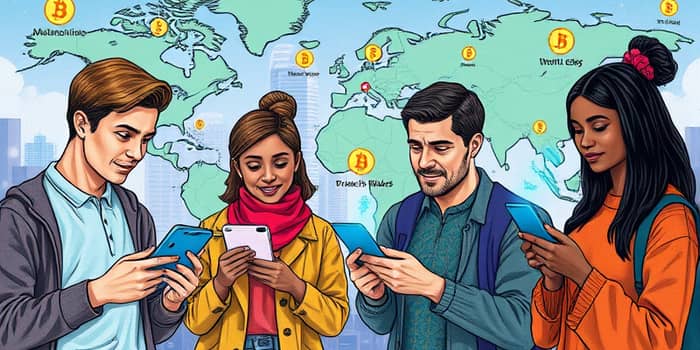
From humble beginnings in the late 1990s to today’s multifaceted digital ecosystems, wallets on our phones and devices have redefined money itself. Their journey is a testament to innovation, inclusion, and the human desire for simplicity.
Historical Journey from Cash to Code
Long before smartphones, visionaries imagined replacing coins and notes with bits and bytes. Early experiments like Coca-Cola’s 1997 SMS vending machine hinted at a future where text messages could buy a soda. In parallel, David Chaum’s digital cash research in the 1980s laid the cryptographic foundation for secure electronic payments.
- Pre-2000s: Confinity (later PayPal) launches in 1999 for online payments
- Early 2000s: Mobile purchases for movie tickets; Alipay debuts in 2004
- Late 2000s: M-Pesa transforms African economies in 2007; Venmo emerges in 2009
- 2010s: Google Wallet (2011), Apple Pay (2014), Samsung Pay (2015); Bitcoin sparks crypto wallets
Each milestone marked a leap toward seamless global commerce without physical currency, gradually weaving digital wallets into daily life.
Market Growth and Adoption
Today, digital wallets aren’t niche—they’re mainstream. In 2025, the global market reached $56.77 billion, propelled by a staggering 20.9% CAGR, and is projected to top $145 billion by 2030. User adoption mirrors this boom: over 4.5 billion people held a wallet in 2025, more than half the world’s population, with forecasts exceeding 6 billion by 2030.
Transaction volumes soar as well. QR-code and contactless payments accounted for 83% of digital payment volume in 2024, with QR alone registering 380 billion transactions worth $5.4 trillion. By 2029, overall transaction value is expected to surpass $17 trillion, exhibiting 11.2% annual growth.
Expanding Horizons: Beyond Payments
Digital wallets have grown from simple transaction tools into multifunctional hubs, delivering a host of new services:
- Identity & Credentials: Storing government IDs, transit passes, tickets
- Crypto & DeFi Access: Managing tokens, NFTs, smart contracts directly
- Financial Inclusion: Extending services to unbanked regions through mobile money
By integrating NFC, blockchain, and AI, wallets now offer control over personal digital identities and unprecedented financial inclusion in emerging markets. This evolution empowers individuals to transact, verify, and invest without intermediaries.
Key Players Shaping the Future
While pioneers like PayPal and Alipay paved the way, tech giants drive contemporary growth. In the U.S., Apple Pay claims 38% market share, PayPal 28%, and Google Pay 15%. Overlaps are common: nearly 89% of Apple Pay users also maintain a PayPal wallet for broader functionality.
Regionally, Asia’s superapps such as Alipay and WeChat Pay dominate daily life, while Africa’s mobile money innovators like M-Pesa continue championing financial inclusion. Crypto enthusiasts rely on MetaMask and Trust Wallet for decentralized finance, keeping pace with evolving user demands.
Practical Tips for Users and Businesses
To leverage digital wallets effectively and securely, consider the following guidance:
- Choose trusted providers offering robust security measures like multi-factor authentication.
- Regularly update your app and device to protect against vulnerabilities.
- Set customizable transaction limits for added protection on high-value transfers.
- Enable biometric locks or PINs to secure wallet access swiftly.
- Explore loyalty and rewards features to maximize everyday spending benefits.
Businesses can integrate wallet payments by partnering with major platforms, ensuring compatibility with QR codes and NFC terminals. Encouraging wallet usage not only accelerates checkout but also fosters customer loyalty through exclusive digital offers.
Looking Ahead: Trends and Projections
Innovation accelerates. Artificial intelligence promises personalized spending insights, fraud detection, and voice-activated transactions. Blockchain advances will bolster identity verification and permit self-sovereign identity frameworks, granting users user-controlled data ownership without third-party oversight.
Contactless payments continue their ascent, projected to rise 221% between 2022 and 2026. By 2030, mobile wallets may process 65% of online purchases and 45% of point-of-sale transactions, reshaping retail and service industries.
Conclusion
Digital wallets have transcended mere payment tools to become central to modern economic life, weaving together finance, identity, and technology. As they continue evolving, they promise instant peer-to-peer transfers across borders and empower users with unprecedented agency.
Whether you’re a consumer seeking seamless transactions or a business aiming to delight customers, embracing the digital wallet revolution unlocks a future of inclusion, security, and innovation. The only limit is our imagination.
References
- https://mydocsafe.com/the-evolution-of-digital-wallets/
- https://sqmagazine.co.uk/digital-wallet-statistics/
- https://www.fxcintel.com/research/reports/history-e-wallet-market-evolution-growth
- https://capitaloneshopping.com/research/digital-wallet-statistics/
- https://techcrunch.com/2016/06/17/the-evolution-of-the-mobile-payment/
- https://www.thebusinessresearchcompany.com/report/digital-wallet-global-market-report
- https://www.checkout.com/blog/evolution-mobile-wallets
- https://business.bofa.com/en-us/content/digital-wallets-adoption-digital-payments-strategy.html
- https://truust.io/blog/the-evolution-of-payments-industry/
- http://innovationinsights.mastercard.com/innovation-primers-digital-wallet
- https://y.uno/post/history-of-digital-payments
- https://www.juniperresearch.com/research/fintech-payments/core-payments/digital-wallet-research-report/
- https://www.paragonedge.com/blog/a-look-at-the-history-of-credit-cards-and-the-evolution-of-payments
- https://www.statista.com/outlook/fmo/payments/digital-payments/worldwide
- https://www.icterra.com/the-history-and-future-of-payment-trends/