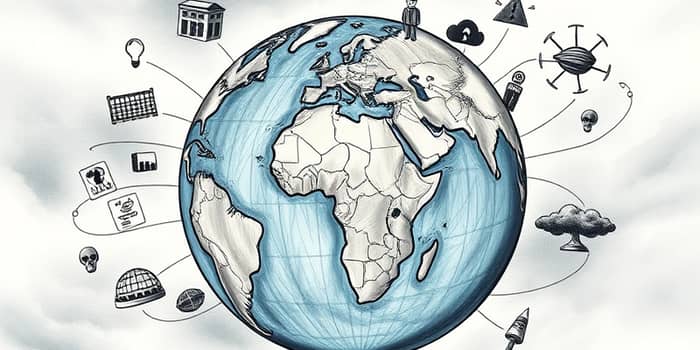
As we stand at the threshold of 2026, the world faces a web of challenges where crises no longer unfold in isolation. Emerging threats—from geopolitical tensions to climate vulnerabilities—are converging in what experts call a global polycrisis with cascading effects. Understanding these interconnected risks is the first step toward building resilience and securing a more stable future.
This article delves into the top risks identified by leading authorities and offers practical strategies to navigate an era defined by uncertainty. By drawing on insights from the World Economic Forum, Eurasia Group, and the Stimson Center, we chart a path forward amid escalating great-power competition, technological disruptions, and environmental stressors.
Understanding the Polycrisis Landscape
The term "polycrisis" describes how distinct threats—economic, political, technological, and environmental—amplify one another. In 2026, rising geoeconomic confrontation and eroding multilateral trust sit at the heart of this phenomenon. Protectionist trade wars undermine cooperation, while digital disinformation deepens societal divides, fueling political unrest and jeopardizing collective action on global challenges.
Experts warn that without coordinated responses, localized shocks can trigger global shocks. A severe economic downturn in one region can cascade into supply chain disruptions elsewhere, while unchecked climate events may displace millions and exacerbate geopolitical rivalries. Recognizing these links is essential for designing integrated solutions.
Key Global Risks Shaping 2026 and Beyond
Leading organizations rank risks differently, but common themes emerge. Below is a synthesis of the highest-priority threats across short- and medium-term horizons:
- Geoeconomic confrontation: Rising protectionism and trade fracturing multilateral frameworks.
- Political instability in major powers, notably a potential US constitutional crisis.
- Technological disruption from extractive AI models and cybersecurity breaches.
- Nuclear escalation as arms control treaties lapse and stockpiles expand.
- Worsening climate vulnerabilities leading to resource conflicts.
The Rise of Geoeconomic Confrontation
According to the World Economic Forum, geoeconomic competition is the top risk for 2026, with over 18% of respondents citing it as critical. Governments are increasingly weaponizing tariffs, investment restrictions, and subsidies to protect domestic industries. This shift erodes trust in multilateral rule of law and raises the likelihood of widespread trade wars.
Such tactics not only stifle economic growth but also threaten supply chain integrity. Companies and policymakers must foster transparency, diversify sourcing strategies, and engage in diplomatic dialogue. Rebuilding international institutions and negotiating binding trade agreements can help stem further fragmentation.
Political Instability and Rogue Powers
Uncertainty in the United States—driven by potential constitutional assaults on checks and balances—ranks as Eurasia Group’s top risk. A domestic power grab could weaken US leadership, prompting allies to question security commitments and escalating instability in regions reliant on American support.
Elsewhere, hybrid warfare tactics by Russia and assertive maneuvers by China in the South China Sea intensify tensions. Democracies grappling with internal polarization must safeguard institutions, uphold civil liberties, and invest in public education campaigns that counteract disinformation.
Technological Disruptions: AI and Cyber Threats
AI’s rapid advancement brings both promise and peril. Extractive business models that monetize personal data pose societal risks, while overreliance on automated decision-making can deepen inequalities. Eurasia Group warns of an "AI eats its users" scenario where dominant platforms undermine public trust.
Simultaneously, cyberattacks on critical infrastructure—from power grids to financial systems—threaten cascading failures. Governments and corporations must establish robust regulatory frameworks, invest in defensive capabilities, and foster international norms for responsible AI development and cybersecurity cooperation.
Nuclear Escalation in a Multipolar World
With the New START treaty expiring in early 2026 and major powers expanding warhead stockpiles, the risk of nuclear escalation has surged. The Stimson Center highlights that tactical nuclear doctrines and proliferation into emerging states further destabilize deterrence balances.
Diplomatic renewal of arms control agreements, coupled with confidence-building measures and verification protocols, is urgently needed. Civil society can pressure governments to recommit to nonproliferation and support programs that reduce fissile material stockpiles.
Economic Volatility and Diverging Growth
After a modest rebound, the global economy faces a 2.7% growth forecast in 2026, according to PwC. Yet this headline figure belies stark divergences: advanced economies struggle with inflationary pressures, while emerging markets contend with debt distress and capital flight.
IMF analyses warn that uneven recoveries may entrench a K-shaped trajectory, where wealth concentration and high living costs fuel social unrest. Policymakers should design targeted stimulus measures, reform tax systems to support middle- and lower-income groups, and strengthen financial safety nets.
Regional Hotspots Table
Climate Vulnerabilities and Resource Competition
Climate risks—including extreme weather events and water scarcity—intensify geopolitical rivalries. Nations may weaponize water flows or contest access to arable land, sparking cross-border tensions. The polycrisis magnifies when natural disasters coincide with political turmoil and economic distress.
International cooperation on climate adaptation, investment in resilient infrastructure, and equitable water-sharing agreements can alleviate pressures. Civil society must amplify marginalized voices and push for ambitious emissions reductions, even when some governments retreat from commitments.
Strategies to Mitigate 2026 Risks
Amid this daunting outlook, clear strategies can reduce vulnerabilities and foster global stability:
- Rebuild multilateral institutions: Reinforce transparency and the rule of law in trade and security.
- Enhance democratic resilience: Defend checks and balances and invest in civic education.
- Regulate technology responsibly: Promote open-source AI and establish cybersecurity norms.
- Renew arms control frameworks: Extend treaties, support nonproliferation diplomacy.
- Address inequality: Implement progressive fiscal policies and strengthen social safety nets.
- Invest in adaptation: Fund climate-resilient infrastructure and sustainable resource management.
Conclusion: Navigating an Unsettled Future
2026 presents a landscape where risks collide, reinforcing one another in unpredictable ways. Yet by acknowledging their interdependence and pursuing integrated responses, societies can build resilience and unlock opportunities for cooperation.
From revitalizing multilateralism to regulating emerging technologies and combating climate threats, collective action remains our strongest safeguard. The journey ahead demands vision, solidarity, and unwavering commitment—to confront today’s challenges and shape a more secure world for generations to come.
References
- https://www.weforum.org/publications/global-risks-report-2026/digest/
- https://www.eurasiagroup.net/issues/top-risks-2026
- https://www.stimson.org/2026/top-ten-global-risks-for-2026/
- https://www.pwc.com/us/en/about-us/newsroom/press-releases/annual-outlook-2026.html
- https://www.imf.org/en/publications/weo/issues/2026/01/19/world-economic-outlook-update-january-2026
- https://www.marsh.com/en/risks/global-risk/insights/top-global-risks-in-2026.html
- https://investments.metlife.com/insights/macro-strategy/global-risks-outlook-2026/
- https://www.weforum.org/publications/global-risks-report-2026/