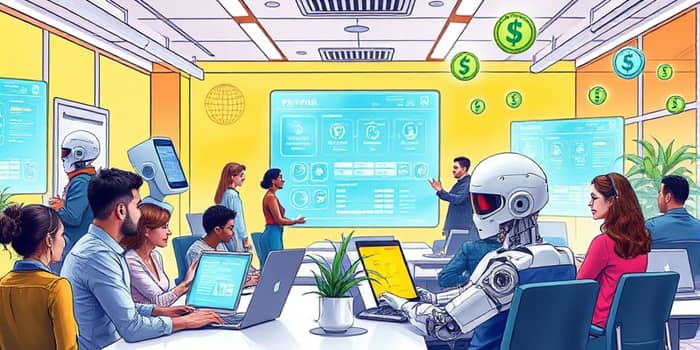
As organizations expand across borders and adopt hybrid work models, payroll is no longer a mere administrative afterthought. In 2026, cutting-edge systems and pioneering services turn this vital function into a catalyst for strategic growth, compliance and employee satisfaction.
AI and Automation in Payroll
Today’s payroll engines leverage artificial intelligence to streamline every stage of compensation. From automated data entry that learns from past inputs to advanced calculations that factor in myriad allowances, AI is reshaping the landscape. According to recent surveys, 77% of HR executives now use AI in payroll, and finance teams report a 20% improvement in accuracy with AI integrations.
More than simple computation tools, AI modules deliver real-time performance data dashboards that reveal labor cost trends, overtime spikes and forecasting insights. By identifying anomalies at the source—whether a misentered timesheet or a tax withholding error—systems achieve continuous data validation and error checks, reducing manual review times by up to 30%.
Real-Time Processing and Instant Payments
Gone are the days of weekly or biweekly payroll runs that leave employees waiting for their pay. Modern platforms offer same-day settlement options, front-end preview tools and instant access to historical pay records. Every transaction flows through a transform payroll into a strategic driver mindset, enabling finance leaders to spot budget overruns and adjust forecasts on demand.
- Faster pay cycles boost employee morale and retention.
- Real-time visibility reduces reconciliation efforts by 40%.
- Automated alerts flag unusual patterns immediately.
Earned Wage Access and Financial Wellness
Earned wage access (EWA) platforms empower workers to tap into their earnings before payday. In 2022, over 7 million employees accessed advances totaling $22 billion. Beyond alleviating financial stress, EWA programs act as low-friction retention tools that decrease turnover rates among hourly staff by up to 15%.
When combined with personalized financial coaching, savings nudges and in-app budgeting tools, EWA becomes part of a broader employee-centered financial wellness strategy. Organizations that embed these services into benefits portals report measurable uplifts in productivity and overall satisfaction.
Compliance and Regulation Management
As companies hire across states and countries, regulatory demands multiply. From multistate tax filings to evolving paid leave mandates, missteps can trigger fines of 10–30% of payroll expenses. Today’s payroll suites incorporate proactive compliance management tools that auto-update local wage rates and leave policies, while AI-driven rule engines track changes in real time.
- 57% of payroll professionals cite local compliance as their top challenge.
- Automated classification checks reduce misclassification risk significantly.
- Global reporting modules simplify cross-border payroll runs.
Payroll-HR Integration and Diverse Workforce Support
Unified HCM solutions bring payroll, benefits and time tracking onto a single platform. This seamless integration means that managers can set PTO rules, run headcount analyses and process pay changes without toggling between systems.
With 81% of workers favoring hybrid or remote roles, these platforms must also handle contractors, gig workers and international hires. By offering personalized employee self-service portals, organizations enable staff to view payslips, update tax forms and request advances, all in local language and currency.
Predictive Analytics and Cost Optimization
Advanced analytics predict future payroll expenses by analyzing hiring trends, project budgets and historical overtime. These insights inform staffing decisions, help optimize shift patterns and flag departments exceeding labor budgets. Predictive engines can also simulate the impact of a new minimum wage law or a change in employer contribution rates.
Personalized Employee Experiences and Transparency
Pay transparency policies are on the rise, and employees demand open access to compensation frameworks. Custom portals now display breakdowns of base pay, bonuses, tax withholdings and benefit deductions. This transparency fosters trust and helps curb disparities.
Meanwhile, benefits bundles adapt dynamically to location costs, family status and tenure. A worker in a high-cost city might see enhanced commuter allowances, while a contractor on an international assignment receives localized tax support.
Integration with Emerging Technologies
Blockchain is finding its way into payroll for secure and transparent transactions over blockchain. Immutable ledgers ensure every transaction is verifiable, cutting fraud risk. Cloud-native architectures deliver global scalability and real-time data synchronization, while biometric authentication secures access to sensitive pay information.
Key Statistics at a Glance
These figures underscore the rapid evolution of payroll from a back-office cost center to a strategic asset that drives agility and engagement.
Challenges and Future Outlook
Despite rapid innovation, obstacles remain. Data security concerns persist as systems centralize sensitive information. In addition, some finance teams lag in AI adoption, preferring manual review cycles. Multinational entities still grapple with divergent regulations and cultural nuances.
- Greater focus on AI governance and ethics frameworks.
- Expansion of pay transparency laws across more jurisdictions.
- Rise of skills-based compensation models linked to performance.
Looking ahead, organizations that embrace these trends will unlock unprecedented efficiency and talent loyalty. By treating payroll as a strategic partner rather than a transactional necessity, businesses can adapt to fluid labor markets, manage costs proactively and foster a culture of trust and financial wellness.
In the future of work, payroll innovations will not just keep the lights on—they will illuminate the path to sustainable growth.
References
- https://www.paychex.com/articles/payroll-taxes/new-year-payroll-trends
- https://zalaris.com/managed-services/resources/blog/the-role-of-ai-in-payroll-trends-to-watch-in-2026
- https://journeypayrollhr.com/2025/11/13/the-future-of-payroll-and-hr-trends-to-watch-in-2026-and-beyond/
- https://www.usemultiplier.com/global-payroll/future-of-global-payroll
- https://www.asuresoftware.com/blog/3-payroll-hr-trends-every-business-leader-should-watch-in-2026/
- https://www.adp.com/spark/articles/2025/12/key-hr-technology-trends-for-2026-and-how-to-plan.aspx
- https://www.innovativeemployeesolutions.com/blog/5-workforce-trends-to-watch-in-2026-whats-next-for-ai-global-hiring-and-compliance/
- https://workforce.com/news/hr-and-payroll-trends-2026
- https://www.adp.com/spark/articles/2025/12/key-hr-compliance-trends-for-2026-and-how-to-get-ahead.aspx
- https://www.irisglobal.com/blog/2026-payroll-compliance-update/
- https://www.sentinelgroup.com/resource-center/2026/6-hr-trends-for-2026
- https://www.paylocity.com/resources/learn/articles/anticipating-workforce-trends-2026/
- https://myhrconcierge.com/2026/01/08/top-hr-trends-that-will-shape-the-workplace-in-2026/