In our modern economy, credit cards have evolved beyond simple payment tools into powerful psychological triggers. Their design taps directly into the brain’s reward system, reshaping how we perceive and engage with money. By understanding these underlying forces, readers can reclaim control of their finances and make more intentional choices.
Core Psychological Mechanisms Driving Spending
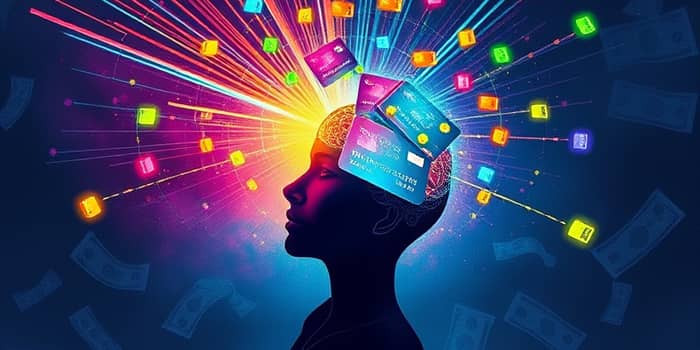
Research shows that swiping a credit card is more than a neutral transaction. It is activating the brain’s dopaminergic reward center, the same network involved in processing pleasure and anticipation. This direct activation energizes us to purchase rather than simply reducing the discomfort of payment.
Rather than merely releasing the brakes on spending, cards produce a “step on the gas” effect. The sensation of immediate acquisition, combined with delayed billing separating action from consequences, reinforces behavior until it becomes habitual or even addictive.
Spending Increase Statistics and Experiments
Multiple experiments highlight the dramatic impact of credit versus cash. In an MIT silent auction, bidders using cards offered twice as much as cash bidders, suggesting that one credit dollar feels like fifty cents in psychological cost. In dining settings, credit users tip over 4% more than cash payers. The pattern is consistent across shopping contexts: higher prices, larger tips, and more impulse buys.
- MIT fMRI study: Cards sensitize reward networks and drive higher purchases.
- MIT auction: Card users bid more than twice cash bidders.
- Journal of Applied Psychology: Diners tip 4.3% more with cards.
Rewards, Gamification, and Behavioral Triggers
Credit card issuers enhance engagement through sophisticated gamification. Point systems, tiered bonuses, and limited-time offers create a powerful sense of scarcity and entitlement. Fear of missing out intensifies the urge to spend, with mental calculations justifying annual fees in exchange for future reward trips.
Such structures rely on instant gratification from immediate acquisition. The promise of miles or cashback erects a mental bridge that downplays long-term costs, reinforcing recurrent spending patterns.
Emotional and Personality Factors
Spending often serves as an emotional coping strategy. In moments of stress, sadness, or celebration, the ease of swiping a card provides fleeting relief. However, this relief can quickly give way to remorse and mounting bills.
Research identifies specific traits linked to compulsive overspending:
- Need for arousal and sensation-seeking tendencies
- Emotional instability and impulse control challenges
- High materialism and self-esteem tied to possessions
- Introversion leading to online retail therapy
- Low conscientiousness and poor budgeting habits
Credit misuse stands out as the strongest predictor of compulsive buying behavior, fueling a cycle of debt, anxiety, and strained relationships.
Vulnerabilities and Consequences
Individuals vary in their susceptibility to these influences. Optimists may underestimate financial risks, while pessimists remain vigilant but potentially miss out on genuine benefits. Vulnerable groups—those with emotional instability or high materialism—face the greatest danger of developing addiction-like spending habits.
Contrasting Payment Methods and Implications
Not all payment methods are created equal. Cash transactions engage the insular cortex, where loss registers as a physical pain. This immediate feedback often curbs impulse buys and strengthens post-purchase attachment, boosting loyalty and satisfaction.
Practical Strategies to Regain Control
Awareness is the first step toward financial freedom. By identifying triggers and restructuring habits, consumers can mitigate overspending and cultivate healthier money practices.
- Track every purchase to enhance transparency and accountability.
- Use cash envelopes for discretionary budgets to reconnect value to money.
- Limit reward cards to one or two that align with essential expenses.
- Schedule regular “billing reviews” to confront balances promptly.
- Practice mindfulness techniques before each transaction to pause temptation.
These simple yet effective steps support reconnecting spending habits with mindful awareness and breaking cycles of compulsive debt accumulation.
Conclusion
Credit cards offer convenience and rewards, but they also wield profound psychological influence. By tapping into neural reward pathways and masking payment pain, they can drive us to spend beyond our means. Recognizing these forces empowers individuals to make deliberate choices, balancing benefits with caution.
Through informed awareness, strategic payment methods, and mindful financial habits, readers can harness the advantages of modern payment systems without succumbing to their pitfalls. Ultimately, understanding the psychology behind credit card spending paves the way for more intentional, fulfilling, and debt-free lives.
References
- https://mitsloan.mit.edu/experts/how-credit-cards-activate-reward-center-our-brains-and-drive-spending
- https://www.eyes4research.com/store-credit-cards-do-they-encourage-higher-consumer-spending/
- https://www.bankrate.com/credit-cards/advice/psychology-of-credit-card-spending/
- https://freshcredit.com/the-psychology-of-credit-understanding-consumer-behavior/
- https://www.nerdwallet.com/credit-cards/learn/credit-cards-make-you-spend-more
- https://pmc.ncbi.nlm.nih.gov/articles/PMC12174854/
- https://www.moneyfit.org/psychology-of-credit-card-debt/
- https://betterworld.mit.edu/spectrum/issues/winter-1999/the-psychology-of-spending/
- https://www.indusind.bank.in/iblogs/credit-card/the-psychology-of-credit-card-spending-how-to-avoid-impulse-purchases/
- https://www.cmu.edu/homepage/practical/2007/winter/spending-til-it-hurts.shtml
- https://pmc.ncbi.nlm.nih.gov/articles/PMC11939284/
- https://news.nd.edu/news/cash-or-card-consumers-pay-strategically-to-forget-guilty-purchases-study-shows/